
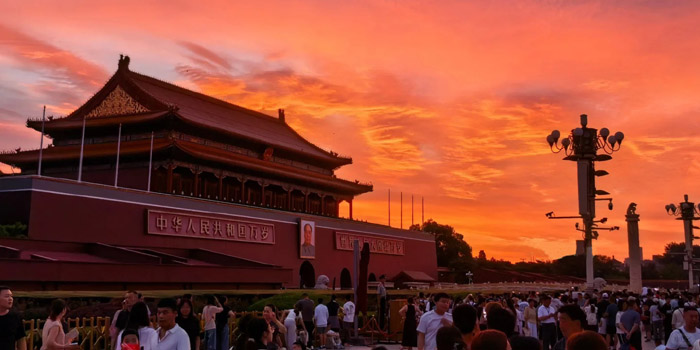
Tiananmen Square: The Guide I Wish I Had on My First Trip
Last verified: August 19, 2026. Some rules shift overnight for state events — always double-check the official portal the night before.
I’ve spent years walking friends and family around central Beijing, and I’ve made just about every classic mistake you can make visiting Tiananmen Square. I once showed up at 6 a.m. without a reservation and got turned away straight away. I queued for ages at Gate 2 because my map app sent me there, wasting 55 minutes of my morning. Another time, I forgot a power bank sat in my jacket pocket and couldn’t enter Chairman Mao Memorial Hall; I had to rush back to the storage area and lost my spot in line.
This is the guide I share with every first-time visitor now. No filler, no copy-pasted Wikipedia history lessons. It only covers practical, on-the-ground advice you’ll actually need standing in the plaza with a dying phone and security staff asking you to return to storage.
The One Thing That Will Ruin Your Day
If you take nothing else away from this piece: you cannot simply walk in. Since 2021, every visitor must complete a real-name reservation to enter the square, even though admission is free. No booking means no entry. I’ve watched travelers argue with security guards at 5:30 a.m. The staff hear every excuse, and they cannot bend the rules.
Official reservation portal: https://yuyue.tamgw.beijing.gov.cn
Official management website: https://tamgw.beijing.gov.cn
The booking system undergoes maintenance around 22:00 each night. I learned this the hard way, trying to reserve a spot for a friend at 22:15 only to hit a broken page. Complete all bookings before 21:50 to avoid disruption.
Reservation window: Book Tiananmen Square 1–10 days ahead. Same-day reservations are not available.
The lesser-known exemption hack: If you already hold a confirmed same-day ticket for any of these sites, a separate square reservation is not required:
- Chairman Mao Memorial Hall
- National Museum of China
- Forbidden City
- Zhongshan Park
- Beijing Working People’s Cultural Palace
BUT — and this is critical — this exemption does not apply to the flag-raising or flag-lowering ceremonies. Those events need a dedicated ceremony reservation, and you must enter through the exact checkpoint selected during booking. I once tried switching from Gate 7 to Gate 4 for a shorter queue; staff sent me all the way to the back. Don’t repeat my mistake.
When to Go (And When to Stay in Bed)
The Seasons
Spring (March–May) and autumn (September–November) are ideal visiting windows. Air quality is usually better, the natural light is warm, and you won’t be sweating heavily by 9 a.m. This is when I bring guests who want to appreciate the architecture instead of fighting through heat exhaustion.
Summer (June–August) is tough. High humidity, massive crowds, and longer security queues as visitors grow impatient. That said, if you can handle busy conditions, floodlights illuminate all major buildings after dark and create stunning photo opportunities. I took a 9 p.m. walk in July once and nearly had the eastern plaza edge to myself.
Winter (December–February) is my personal secret favorite. Yes, it is freezing. Wind sweeping across the open plaza cuts right through layers. Yet crowds thin dramatically, and the vast scale of the square feels far more immersive with only dozens of visitors around. I visited with my brother in mid-January and got front-row spots for flag lowering with zero effort. Pack a hat covering your ears — the wind finds every gap in your clothing.
The Daily Rhythm
For the flag raising, check the official schedule one day in advance. Times shift with sunrise. In mid-August 2026, the ceremony starts roughly 5:30 a.m.; by late September, it moves closer to 6:10 a.m.
The busiest time windows:
- 5:00–8:00 a.m. after flag raising ends, as visitors linger for photos
- 9:00–11:00 a.m., when tour buses arrive in large groups
- 4:00–6:00 p.m., sunset crowds plus visitors waiting for flag lowering
Quieter windows (Tuesday–Thursday work best):
- 6:30–7:30 a.m. after the early morning crowd disperses, with gentle morning light
- 12:00–2:00 p.m., most tourists head indoors for lunch; bring sunscreen
- After 8:00 p.m., day trippers leave, buildings light up, and the plaza feels completely transformed
National Day (October 1–7) and Labor Day (May 1–5) are peak chaos. Security queues can stretch longer than one hour. I avoid visiting during these holiday weeks entirely.
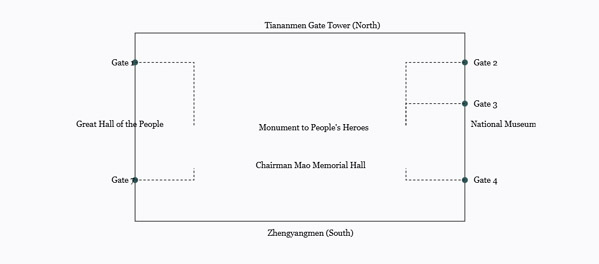
The Five Checkpoints: Picking the Right Gate Will Save You an Hour
This tactical choice affects your whole visit. Most travelers follow navigation app directions, which almost always route them to Gate 2. That explains why Gate 2 is constantly congested.
Gate 1 (Tiananmen West) — My Default Choice
Best for: Photographing the Gate Tower, morning flag ceremonies, continuing north toward heritage sites
Metro: Line 1, Tiananmen West, Exit A or B
Taxi: Request drop-off at the west gate of the National Centre for the Performing Arts, near Dongrongxian Hutong and Shibei Hutong crossing
This gate consistently offers faster entry. On a Saturday morning in February, visitors without bags cleared security in roughly 30 minutes, while the bag-check queue at Gate 2 took over an hour. Tour groups rarely use this entrance. For first-time visitors, this is always my starting recommendation.
Gate 2 (Tiananmen East) — The Trap
Best for: Honestly? Very few scenarios.
Metro: Line 1, Tiananmen East, Exit B
Taxi: East gate of Zishutang
Every navigation app directs travelers here, creating a permanent bottleneck. I only use this gate if my accommodation sits immediately adjacent, and even then I often walk over to Gate 1 instead.
Gate 3 (National Museum) — The Express Lane
Best for: Visitors heading to the National Museum of China
Metro: Line 1, Tiananmen East, Exit C
Taxi: Rui’an Hotel, No. 7 Zhengyi Road
If you hold a museum reservation, this is your dedicated checkpoint. It sits separately from main square crowds. I’ve walked through in under five minutes while main plaza queues wrapped around barriers. Do not queue at other gates and attempt to cut across; you will waste extra walking time.
Gate 4 (Qianmen South) — The Afternoon Secret
Best for: Chairman Mao Memorial Hall, Great Hall of the People, Qianmen Street exploration
Metro: Line 2 or 8, Qianmen Station, Exit B
Taxi: South gate of the Central Research Institute of Culture and History
This gate is extremely busy before noon with tour groups, memorial hall visitors, and ceremony spectators. In contrast, I passed through at 3:15 p.m. on a Wednesday and completed security screening in just three minutes. If your itinerary is flexible, schedule southern landmark visits for the afternoon.
Gate 7 (Qianmen South-West)
Best for: Great Hall of the People, Chairman Mao Memorial Hall
Metro: Line 2 or 8, Qianmen Station, Exit C
Taxi: State Grid Beijing Electric Power Company, No. 41 Qianmen West Street, or Xijiaominxiang
Crowd patterns match Gate 4: avoid arriving before noon; entry becomes smooth after 3 p.m.
What You’re Actually Looking At
I won’t deliver a lengthy history lecture, but basic context makes the whole site easier to appreciate.
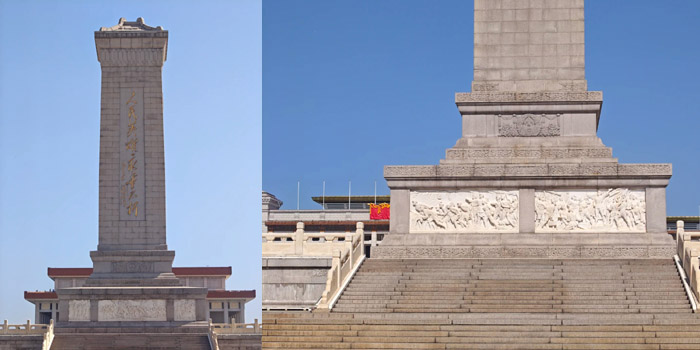
The Monument to the People’s Heroes sits perfectly at the plaza center. It reaches 37.94 meters tall, built using more than 17,000 pieces of granite and white marble between 1952 and 1958. Mao’s inscription appears on the front; the rear text was drafted by Mao and engraved under Zhou Enlai’s supervision. Side relief carvings feature wreaths, pine branches, and stars. It feels far more imposing up close than standard photos suggest.
Chairman Mao Memorial Hall occupies the southern end of the plaza, opening to visitors in 1977. The central viewing hall holds Mao’s crystal casket, placed on a Mount Taishan black granite base.
Practical notes from multiple personal visits:
- Book 1–6 days ahead. New slots release daily at 12:30 PM Beijing time and sell out rapidly.
- No bags, power banks, food, or drinks allowed. Free storage sits on the eastern side of the square, but it adds travel time.
- Photography inside is prohibited, even casual snapshots. Security staff monitor visitors closely.
- International visitors without Chinese ID: Ask at the southeast corner International Visitors Desk about potential same-day slots. Arrive before noon. This occasionally works, but never plan your trip relying on it.
- Opening hours: Tuesday–Sunday, 8:00 a.m.–12:00 p.m. Closed every Monday.
Zhengyangmen (Qianmen) at the southern boundary dates back to 1419. The gate tower, arrow tower, and barbican represent some of the best-preserved Ming and Qing defensive architecture across Beijing. The Beijing Folk Customs Museum operates inside the tower.
Reservations use the WeChat mini-program Beijing Central Axis Heritage Protection Center. New slots go live at 5:00 p.m. daily for bookings 1–7 days in advance. Admission remained free during the 2025 trial period, but always verify current policies before travel, as rules may adjust without advance notice. Open Tuesday–Sunday, 9:00 a.m.–5:00 p.m., final entry at 4:30 p.m. Closed Mondays. Helpline: 010-63159185.
Tiananmen Gate Tower anchors the northern edge of the square. Standing 33.7 meters high and covering 4,800 square meters, it features double-eaved yellow glazed roofing decorated with dragon and phoenix carvings. First constructed in 1417, it burned twice before reconstruction and renaming in 1651 during the Qing Dynasty.
The Huabiao stone columns flanking the gate are original Ming Dynasty pieces from 1420. Each stands 9.57 meters tall and weighs over 20 tons, carved with cloud and dragon motifs. The south-facing pair is called “Wangjun Gui” (hoping the ruler returns promptly); the north-facing pair “Wangjun Chu” (urging the ruler to travel out and listen to citizens).
The stone guardian lions in front bear a scar on one belly. Two common explanations circulate: damage from Li Zicheng’s rebel troops in the Ming Dynasty, or impact from the Eight-Nation Alliance in 1900. I’ve heard tour guides share both versions on the same day.
The Golden Water Bridge directly in front has five marble arches. The central bridge was reserved exclusively for emperors, with outer lanes allocated to senior officials. Strict hierarchy governed even bridge access in imperial times.
Visiting the Gate Tower interior:
- Ticket price: 15 RMB, book 1–7 days ahead. New slots release daily at 5:00 p.m. Daily visitor cap: 9,000 people.
- Seniors aged 70 and older qualify for free entry but still require a reservation.
- Route is one-way, no backtracking permitted. Once you ascend, you exit northward.
- Bags and power banks cannot be taken inside; storage is available before security. Phones, cameras, and physical ID may be kept with you.
- You do not need to arrive exactly at your booked time, but entry must be completed before closing (3:30 p.m. winter, 4:30 p.m. summer).
- Closed every Monday.
Critical exit tip: After touring the gate tower, the path continues north. If you do not hold a Forbidden City ticket and want to avoid a long walk circling the moat, exit through Zhongshan Park (west) or the Working People’s Cultural Palace (east) to reach subway and taxi pickup zones. I learned this lesson on my third visit and ended up walking an extra 25 minutes.
The Great Hall of the People on the western side was built in just 10 months across 1958–1959. It spans 171,800 square meters with 134 outer columns.
Book 1–3 days in advance via the official WeChat mini-program; same-day bookings are unavailable.
Ticket pricing: 30 RMB for adults, 15 RMB for students, free entry for visitors under 18 or over 60.
Helpline: 0086 10 83084776 (9:00 a.m.–3:00 p.m.).
Opening hours: 8:30 a.m.–3:00 p.m., final entry at 2:30 p.m.
Large luggage, food, bottled water, and selfie sticks longer than 1.3 meters are prohibited. Storage lockers are provided, and multiple ID checks take place inside.
The National Museum of China on the eastern side holds 1.43 million cultural relics. Established in 2003 by merging two older museums, it ranks among the world’s top national museums.
Admission is free, but mandatory reservations open 1–7 days ahead, releasing new slots daily at 5:00 p.m. and selling out quickly.
Opening hours: Tuesday–Sunday, 9:00 a.m.–5:00 p.m., final entry at 4:00 p.m. Closed Mondays unless the Monday falls on a public holiday.
Helpline: +86 10 6511 6400.
A valid museum reservation grants entry into Tiananmen Square, but it does not cover flag ceremony access.
Zhongshan Park (west of the square) and the Working People’s Cultural Palace (east of the gate) are my go-to quiet escapes once the main plaza becomes overcrowded.
Zhongshan Park: Constructed in 1420 as the Altar of Land and Grain, renamed in 1928 to honor Sun Yat-sen. This 23.8-hectare green space offers perfect side-angle shots of Tiananmen Gate without crowds filling the frame.
Working People’s Cultural Palace: Former Imperial Ancestral Temple. Same-day WeChat reservations cost 2 RMB. Opening hours: 9:00 a.m.–4:30 p.m., closed Mondays. Helpline: 0086 010-65116776. This location hosts some of the best low-crowd photo spots across the entire area.
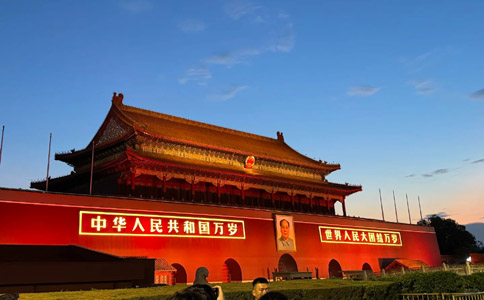
The Night Version (My Favorite)
Most visitors leave once the sun sets. That’s when the square transforms entirely.
The flag-lowering ceremony takes place at dusk. Shorter than the morning raising, it carries a quieter, more intimate mood. Soldiers march in formation, the flag is lowered, and floodlights activate across all major structures.
Afterward, take a slow walk. The Gate Tower glows red and gold under spotlights. The Monument to the People’s Heroes feels heavier and more solemn under lighting. The National Museum and Great Hall illuminate their full facades. Zhengyangmen Tower at the southern end resembles a gateway into old Beijing.
Walking north leads toward the outer moat and lit red walls of the former imperial palace. Heading south brings you to Qianmen Street and Dashilan within 10 minutes, filled with traditional shops, street food, and neon signage. Chang’an Avenue also makes a lovely evening stroll, lined with government buildings featuring subtle exterior lighting.
I completed this walk in late November around 9 p.m. Fewer than 30 people occupied the whole plaza. It felt as if the city handed me the space to explore freely.
A Smarter Way to Walk It
Nearly everyone walks straight down the central axis. Don’t follow that flow.
This is my preferred route:
- Enter from the eastern side near the National Museum of China
- Walk to the Monument and circle it to view the relief artwork
- Loop west past the Great Hall of the People
- Save primary photos of Tiananmen Gate until last, once morning tour groups have moved north
Effective photo tips:
- Low angle: Crouch and shoot upward. This removes most crowds and emphasizes the scale of the gate tower or monument.
- Long zoom from the perimeter: Stand near the plaza boundary and zoom in. This compresses the scene visually and creates the impression of empty space.
- Use barriers creatively: Flower beds, the flagpole base, and stone railings act as natural blockers to hide background crowds.
Hidden viewpoints:
- Just inside Zhongshan Park’s entrance — frame Tiananmen Gate from the side with trees in the foreground, almost no crowds in shot.
- In front of the Working People’s Cultural Palace — classic imperial architecture backdrop with very few other visitors.
Security: What Actually Gets You Stopped
Screening matches airport-level checks, and every guest entering the square or connected venues must complete inspection.
Items strictly prohibited:
- Drones
- Knives or multi-tools
- Selfie sticks of any size
- Food and bottled water inside the Memorial Hall, Great Hall of the People, or Gate Tower
Bring these essentials:
- Physical passport for overseas visitors. Digital copies or phone photos are not reliably accepted; I’ve watched travelers denied entry relying only on saved images.
- Carry as little luggage as possible. Visitors without bags can use the no-bag lane and skip full X-ray screening. On busy days, this difference can mean 10 minutes versus a one-hour wait.
Dress and behavioral guidance:
- Do not climb, mark, or damage any structures.
- Speak quietly inside memorial and government buildings.
- Dress respectfully; beachwear or clothing featuring political slogans is inappropriate for these solemn sites.
The Mistakes I’ve Made (So You Don’t Have To)
- Forgetting reservations. The most common error, and the most embarrassing. Security staff have zero flexibility.
- Trusting navigation apps, which directed me to Gate 2 and cost an hour of waiting time.
- Visiting at 10 a.m. on a Saturday, never repeating that choice.
- Bringing a backpack into the Memorial Hall, forcing a return trip to storage and losing queue position.
- Failing to photograph Tiananmen Gate before entering the tower. The one-way route prevents backtracking, and I missed my best shot.
Three Itineraries That Actually Work
Route A: The Classic Morning
5:15 a.m. — Arrive at Gate 1 for flag raising
6:00 a.m. — Walk the square while crowds remain light
7:30 a.m. — Chairman Mao Memorial Hall (queue early; closes at noon)
9:30 a.m. — Tiananmen Gate Tower
Exit via Zhongshan Park or Cultural Palace to skip the long moat walk
Route B: The Museum & Evening
1:00 p.m. — Enter through Gate 3 (museum lane), visit National Museum of China
4:30 p.m. — Explore the square as afternoon crowds thin
6:30 p.m. — Dinner in Qianmen
7:30 p.m. — Return for flag lowering and night photography
Route C: The Political Landmarks
9:00 a.m. — Great Hall of the People (enter early; closes at 3:00 p.m.)
11:00 a.m. — Chairman Mao Memorial Hall
1:00 p.m. — Tiananmen Gate Tower
2:30 p.m. — Zhongshan Park for quiet rest
Where to Eat Nearby
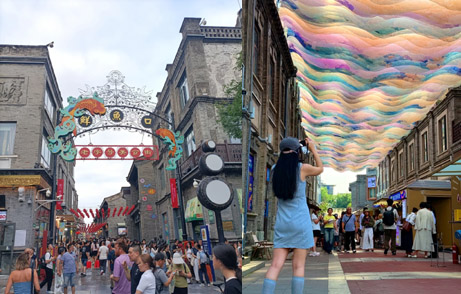
I avoid eating directly on the square. Walk roughly 10 minutes south to Qianmen and Dashilan for better local options.
- Siji Minfu Roast Duck (Dashilan branch): Authentic Peking duck with shorter waits than branches close to the Forbidden City. Online booking opens at 10:30 a.m. daily, make a reservation in advance.
- Mending Meat Pie & Heyan Meat Pie: Budget-friendly, quick local meals ideal for lunch between sightseeing stops.
- Wu Yu Tai Tea House: Camellia and matcha tea ice cream, a refreshing treat on hot summer afternoons.
If Something Goes Wrong
Lost belongings: A dedicated lost-and-found service runs by Tiananmen regional authorities. During major holidays, staff at Party member service posts manage these requests; over the previous May Day period, team members supported more than 18,000 visitor enquiries. Speak to any uniformed staff member for help.
Medical support: The nearest major hospital is Beijing Hospital (No. 1 Dahua Road, east of the square). For minor issues, ask staff; service posts stock basic first-aid supplies.
Police or security concerns: The square maintains heavy patrol coverage. For non-emergencies, approach an officer directly. In an emergency, dial 110, China’s universal police contact number.
Bag storage locations:
Memorial Hall: free storage on the eastern side of the square
Gate Tower, National Museum, Great Hall of the People: each provides on-site lockers
Backup option: Some hotels near Qianmen offer paid luggage storage for non-guests if official lockers are unavailable.
Booking Cheat Sheet (Save This)
| Site | Advance Booking Window | Cost | Slots Release Time | Contact Phone | Regular Closing Day |
|---|---|---|---|---|---|
| Tiananmen Square | 1–10 days | Free | N/A | N/A | N/A |
| Gate Tower | 1–7 days | 15 RMB | 5:00 PM daily | N/A | Monday |
| Memorial Hall | 1–6 days | Free | 12:30 PM daily | N/A | Monday |
| Great Hall of the People | 1–3 days | 30 RMB | Via WeChat | 010-83084776 | N/A |
| National Museum of China | 1–7 days | Free | 5:00 PM daily | 010-65116400 | Monday |
| Zhengyangmen | 1–7 days | Free* | 5:00 PM daily | 010-63159185 | Monday |
| Cultural Palace | Same day | 2 RMB | Via WeChat | 010-65116776 | Monday |
About This Guide
I’m not a travel agent or professional blogger. I’m just someone who has walked these checkpoints dozens of times — in frigid February wind, humid August heat, at 5 a.m. for flag raising, and at 10 p.m. when the plaza sits nearly empty. I’ve made all the common mistakes, mapped shortcuts, and tested timings across every season.
This guide compiles my personal field notes and cross-verifies details against official sources as of August 2026. Policies change, online systems can fail. Always review the official portal the night before your visit.
If this guide helps you, pass the advice forward — point the next confused traveler in queue toward the best checkpoint.