
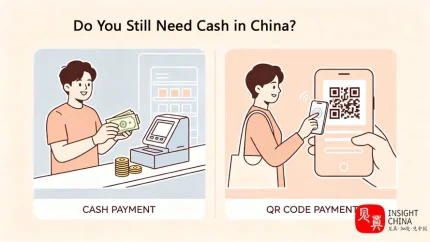
You hand a crumpled ¥100 bill to a street vendor. They stare at it like it’s a museum artifact. Meanwhile, the guy next to you taps his phone for a ¥3 bowl of noodles and walks away. China didn’t just skip the credit card era—it vaulted straight into a phone-tapped economy.
If you’re packing for your first trip and wondering do I need cash in China, the short answer is: not much, but zero physical RMB is a rookie mistake. Here’s the unfiltered breakdown of what actually works on the ground, where your plastic will get rejected, and how much cash to pack without carrying dead weight.
The QR Code Reality (Why Your Card Feels Useless)
Over 80% of daily spend in China runs on WeChat Pay or Alipay. From subway gates to hole-in-wall noodle shops, QR codes are the default. You won’t see card terminals. You won’t hear chip readers beep. You’ll just see locals scanning, paying, and moving on.
For visitors, this creates a simple truth: foreign credit card acceptance China is highly predictable, but tightly confined to international bubbles. Step outside that bubble, and your Visa or Mastercard becomes a very nice coaster.
Where Foreign Cards Actually Work
If you stick to these zones, your card will glide through:
✅ International hotels (4★+): Front desks, in-house restaurants, and spa bookings routinely process overseas cards.
✅ Major airports & duty-free: Beijing Capital, Shanghai Pudong, Guangzhou Baiyun terminals all support foreign cards at retail and dining.
✅ High-end malls: SKP, Taikoo Li, IFC, and similar premium retail hubs accept overseas cards at 90% of stores.
✅ Global chains: Starbucks, McDonald’s, KFC, Zara, H&M—all have POS systems wired for international networks.
✅ Online bookings: Trip.com, Booking.com, and Agoda process foreign cards smoothly for pre-paid hotels.
Where Your Card Will Get Rejected (The Blind Spots)
This is the part most guidebooks skip:
❌ Local Chinese restaurants: Even popular tourist-adjacent spots run QR-only. Terminals are being phased out.
❌ Street food & night markets: Cash or mobile only. No exceptions.
❌ Metro & bus systems: Gates require Alipay/WeChat transit QRs or local transit cards. Foreign cards won’t tap through.
❌ Ride-hailing (DiDi): Requires a linked Chinese payment method. Direct foreign card top-ups rarely work without an intermediary wallet.
❌ Wet markets & neighborhood shops: QR scan or physical notes. That’s it.
The Cash Rule vs. Drawer-Less Reality
Here’s the legal nuance most travelers miss: China’s central bank (PBOC) mandates that all merchants must accept RMB cash by law. Technically, refusing it is illegal.
Practically? Many young shop owners in tier-1 cities have literally removed their cash drawers. They don’t keep change. A polite but firm “I only have cash” usually works, but it’s friction you don’t need.
Smart cash strategy for 2026:
- If mobile payments are set up: Bring ¥500–¥1,000 (~$70–$140) as a backup. Covers temple fees, rural detours, and app glitches.
- If you’re relying on cash only: Bring ¥1,500–¥2,500 (~$210–$350) and accept that you’ll miss out on QR-only transit, local eateries, and seamless ride-hailing.
- Denomination tip: Load up on ¥10, ¥20, and ¥50 notes. Street vendors will groan at ¥100 bills and often can’t break them.
ATM Strategy for Foreign Cards
When you need to top up cash, skip the sketchy standalone machines. Use these:
🏦 Bank of China & ICBC: Highest success rate for Visa/Mastercard. Look for branches inside shopping centers for safety.
🏦 HSBC & Citibank China: English interfaces, Western bank routing, lowest decline rates.
⚠️ Avoid: ATMs in heavy tourist zones (near Tiananmen, major temples). Many are third-party operated and carry higher fees or card-skimming risks.
💡 Withdrawal reality: Expect ¥2,500–¥3,000 per transaction. Your home bank’s international ATM fee + FX spread will apply. Pull what you need, not what’s convenient.
Frequently Asked Questions from Travelers
Do I really need cash in China if I set up WeChat or Alipay?
You need a small buffer. Even with mobile payments locked in, keep ¥500–¥1,000 in small notes. It covers rural markets, older scenic gates, occasional app outages, and vendors who genuinely can’t process QR codes.
How does foreign credit card acceptance China actually work on the ground?
It’s zone-dependent. International hotels, airports, premium malls, and global chains process overseas cards reliably. Local eateries, transit gates, ride-hailing apps, and neighborhood shops operate almost entirely on QR codes or cash. Plan your wallet accordingly.
Can I just use cash everywhere and skip mobile payments?
Legally, yes. Practically, it severely limits your experience. You’ll be shut out of metro gates, DiDi, QR-only restaurants, and museum timed-entry systems. Mobile payments aren’t a luxury in China—they’re the operating system for daily life.
What’s the best way to handle mobile payments China for foreigners without a local bank account?
Set up WeChat Pay or Alipay before departure. Both accept foreign Visa/Mastercards directly. Verification takes 15–20 minutes with your passport and a facial scan. Once linked, you tap, scan, and go—no Chinese bank account required.
Is it true that merchants can refuse cash in China?
No. PBOC regulations explicitly require RMB cash acceptance. In reality, some urban vendors simply don’t carry change. A calm request works 95% of the time. If refused, you can report it, but it’s far easier to just carry small bills or use your mobile wallet.
Paying in China as a tourist doesn’t require a local bank account, but it does require a shift in mindset. Ditch the bulky wallet. Set up one mobile payment app before you fly. Keep ¥500–¥1,000 in crisp, low-denomination notes tucked in your daypack. You’ll navigate street stalls, subway gates, and midnight dumpling runs like a local—just with better battery life and zero change-counting stress.
For step-by-step wallet setup, see our Alipay guide and WeChat Pay walkthrough. For a realistic 2026 daily budget breakdown, check our China trip cost planner. Safe travels, and may your QR scans clear on the first try.
评论已关闭。